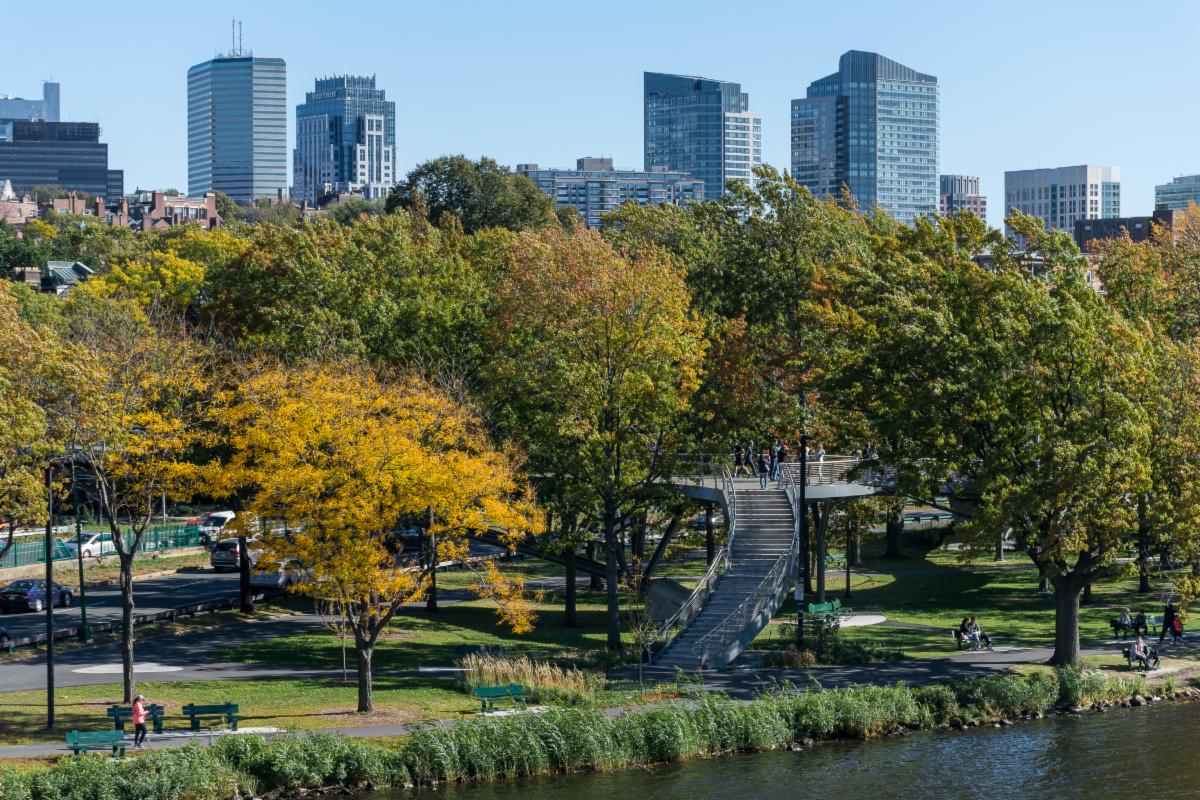
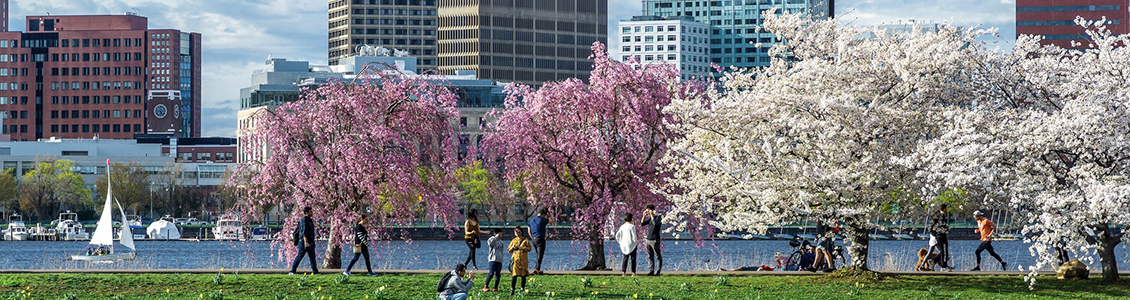
Uniquely situated between the historic urban landscape of Boston and the broad expanse of the lower Charles River, the Charles River Esplanade was designed a century ago and remains one of Boston’s greatest treasures. The Esplanade, like all public spaces, requires constant care, maintenance, and management. Since our founding in 2001, The Esplanade Association has worked tirelessly to restore and enhance this resource. In collaboration with the Department of Conservation and Recreation, supporters and partners, we are improving the park’s beautiful landscape and the experience of its millions of annual visitors.
Accessible Park: With the Department of Transportation (DOT) undertaking a large scale restoration of the Longfellow Bridge, TEA acted swiftly in 2010 to present a working design and solid case for improved connections to the Esplanade and parkland on the Cambridge side. Better connections will improve the experience of all users and address some of the most difficult conditions for pedestrians. Thanks to TEA’s strong advocacy and thoughtful presentation, the DOT is fully committed to this goal. While, two hurdles remain before this project is fully implemented, TEA plans to continue advocating for these improvements.
Volunteers Improving the Park: Though the Esplanade receives millions of visitors every year, it was not until The Esplanade Association launched our successful Volunteer Program in 2004 that individuals had access to an ongoing and organized means of giving back to the park. Now an essential park maintenance and beautification resource, TEA’s volunteer program brings thousands of volunteers who donate their time to the park every year and has won numerous awards from organizations ranging from REI to BostonCares.
Enhancing the Park Visitor’s Experience: The Esplanade is well-used by runners, bikers, and walkers. For years, existing water fountains were not adequate to meet the needs of current use. TEA raised funds to support a study of the existing system and the installation in 2009 of five new fountains that are handicapped accessible and child friendly. These new fountains keep exercisers hydrated and several fountains offer a special spigot for filling a water bottle or dog bowl.
Rehabilitating a Summer Essential: The Esplanade’s wooden docks serve as both landings for visiting boats and as popular spots for people to relax near the water. In 2003 The Esplanade Association launched the first Esplanade dock rehabilitation effort undertaken in decades. Working with both public and private partners the historic Gloucester Street dock was re-decked. In 2006, the River Dock near the park's Arthur Fielder sculpture was replaced and includes enhanced lighting and electrical capacity. The docks are an essential part of the Esplanade’s character as a dynamic riverside park and TEA continues to focus on the replacement of all.
Enriching the Park Visitor Experience
Community Boating Docks: A highly used and essential feature of the Charles River Esplanade, the Community Boating Docks has launched thousands of budding sailors. With deteriorating conditions making the Docks unsafe, The Esplanade Association secured the State’s commitment for complete replacement of the docks and raised, with Community Boating, Inc., $335,000 toward the $2.8 million project. The new docks will expand universal access to sailors with disabilities and will continue to be an essential spot for learning and relaxation.
Bringing Play Back to the Park: A once vibrant and active play space on the Esplanade had, over the years, become rundown and neglected. In 2001 a group of passionate community members came together to raise funds and restore this space, resulting in the installation of the Stoneman Playground. Promoting healthy living with great programs and family-friendly fun is a key objective of TEA. Since 2002 we have focused on providing a variety of free youth programs such as Little Buddies Tulip Planting and the Kids Fishing Club and in 2010 we launched Children in the Park. The newly revived play space and the enriching programs combine physical activity and fun for all.
World Class Fields: Children have learned to play baseball and soccer at the ball fields at Lederman Park for decades, but by the turn of the millennium these beloved fields were ailing from years of overuse. In 2005 a new public-private partnership was formed by TEA, Hill House, The Red Sox Foundation, the Department of Conservation and Recreation, and the MA Executive Office of Environmental Affairs (EOEA) to restore the worn out fields. Together with our nonprofit partners, TEA helped to raise more than $2 million to fund the complete revitalization of the Teddy Ebersol’s Red Sox Fields. The new fields are named in honor of Teddy Ebersol, the youngest son of Dick Ebersol and Susan Saint James, who was killed tragically in a plane crash in 2004. Teddy was a passionate Red Sox fan, and the fields are a vibrant memorial in Teddy’s honor.
Esplanade 2020 & Beyond: The scenic Charles River Esplanade is one of the most beautiful and intensely used parks in the Boston area. An estimated three million individuals visit the Esplanade annually and as many as 20,000 people enter the park on a typical summer’s day. To celebrate the 2010 Centennial of the park, TEA mobilized the community to forge Esplanade 2020 & Beyond, a shared vision for the park’s future. Today, the Esplanade is badly in need of revitalization and strategic long-term care. Esplanade 2020 & Beyond creates a vision and long-term plan for the park’s restoration and enhanced maintenance.
Every Tree is Different: The Esplanade is home to nearly 2,000 trees. Prior to 2004 there was no mechanism to strategically monitor and maintain these valuable park assets. That changed when The Esplanade Association, with the support of Garden Club of the Back Bay and the Beacon Hill Garden Club, commissioned a comprehensive tree inventory for the parkland. Making use of both high-tech GPS positioning and skilled horticultural analysis, this inventory provided the location, species, and condition of every tree on the Esplanade, and helps with assessing tree removal, maintenance, and replanting priorities.
Protecting Endangered Park Jewels: Built in the 1930s, the Esplanade’s three granite landings—Commissioners, Dartmouth Street, and Gloucester Street—serve as overlooks, formal landings for small boats, and popular gathering spots, inviting visitors to step down to the river’s edge. These historic features, designed by landscape architect Arthur Shurcliff, are architectural treasures desperately in need of prompt and careful restoration, and were successfully nominated by The Esplanade Association to Preservation Massachusetts’ Ten Most Endangered Historic Resources Listing.
Would you like to join our efforts?
Photo ©2003 Linda Cox
Privacy | Copyright
| Site Map | Site
Credits
The Esplanade Association
376 Boylston Street, Suite 503
Boston, MA 02116
617.227.0365